Table of content

Convert cubic millimeter to cubic centimeter values fast. Type any mm³ number, choose rounding, and get cm³ instantly. Great for lab notes, 3D printing, engineering drawings, and schoolwork—no extra steps, no distractions.
This converter is built for quick, no-fuss volume conversions. Enter your cubic millimeter value, and you’ll get the matching cubic centimeter result right away—clean, readable, and ready to copy.
Step 1: Enter the volume in mm³
Type your number into the cubic millimeter (mm³) input box. Decimals and large values work fine.
Step 2: Choose rounding (optional)
If you want a tidy result for homework, lab notes, or specs, pick a rounding option (like 2, 4, or 6 decimals). If not, leave it on the default setting.
Step 3: Click Convert
Hit the convert button to run the calculation instantly.
Step 4: Read the result in cm³
Your converted value will appear in cubic centimeters (cm³). Since cm³ is a larger unit than mm³, the converted number often looks smaller.
Step 5: Copy or recalculate with a new value
Copy the cm³ result for your worksheet or report, or simply replace the mm³ input to convert another value in seconds.
That’s it—five steps, no extra formulas to memorize, and you can repeat the process as many times as you need.
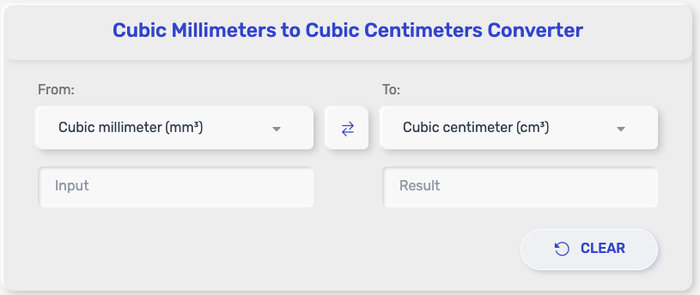
This tool converts cubic millimeters (mm³) into cubic centimeters (cm³) for pretty much any value you’d normally run into—tiny measurements, big volumes, clean integers, or messy decimals. It’s made for quick conversions you can trust, without needing to rewrite anything by hand.
Convert mm³ to cm³ for:
Whole numbers (like 2500 mm³)
Decimals (like 12.75 mm³)
Very small values that would be annoying to convert manually
Scientific notation inputs (for example, 1.2e6 mm³)
Fast re-checks when you want to try different rounding levels
Output formats supported:
Fixed decimals (great when you want a neat result for schoolwork, reports, or lab notes)
Scientific notation (useful when the number is extremely large or extremely small)
If your value looks “too tiny” after converting, that’s normal—cm³ is a larger unit than mm³, so the same volume often shows up as a smaller number in cm³.
Your result is the exact same volume you entered—just written in cubic centimeters (cm³) instead of cubic millimeters (mm³). This is handy when you’re working with specs or notes that prefer cm³, like lab measurements, CAD models, 3D printing material estimates, or product volume details. Nothing about the real volume changes—only the unit label and the way the number is displayed.
Unit cue: mm³ is a very small volume unit; cm³ is larger, so the numeric value usually gets smaller after conversion.
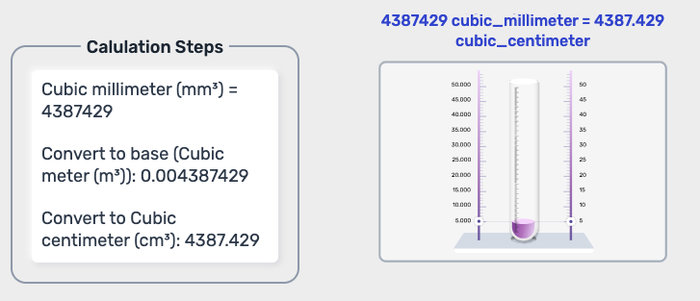
Use this simple conversion: cm³ = mm³ ÷ 1000
That “1000” comes from the metric step 10 mm = 1 cm—and when you convert cubic units, you cube the scale factor: 10³ = 1000.
Here are a few common conversions you can copy fast when you don’t want to type values into the converter.
|
Cubic millimeters (mm³) |
Cubic centimeters (cm³) |
|
1 |
0.001 |
|
10 |
0.01 |
|
100 |
0.1 |
|
1,000 |
1 |
|
10,000 |
10 |
|
100,000 |
100 |
|
1,000,000 |
1,000 |
When you convert cubic millimeters (mm³) to cubic centimeters (cm³), the value often turns into a small decimal. That’s normal—what matters is how you round it for your specific task.
Match the style of the problem, not your calculator.
If the question gives whole numbers, your final answer usually stays tidy (often 1–3 decimals in cm³).
If the question shows a certain number of decimal places, mirror that in your result.
If your teacher mentions “significant figures,” keep the same number of significant digits as the starting value.
Example idea:
If a value is given as 1200 mm³ (no decimals), you typically don’t need a long cm³ decimal trail in the final line.
Rounding too early can quietly distort later steps.
Keep extra digits while you calculate (especially if you’ll multiply, divide, or combine results).
Round once at the end, right before writing the final number in your notes or report.
If you’re recording instrument readings, stick to the precision your instrument actually supports.
Practical tip:
If you’re going to reuse the converted value again (like in a density or concentration calculation), keep more decimals in the middle.
Use the precision that the drawing or spec requires—no more, no less.
Follow the tolerance or the decimal format used in the documentation.
If a spec sheet uses 2 decimals, don’t report 8 decimals unless it’s explicitly requested.
If you’re moving between CAD, slicers, and spreadsheets, keep unit settings consistent so rounding doesn’t stack up across steps.
Rule of thumb:
If your tolerance is around ±0.01 cm³, showing results to 0.000001 cm³ doesn’t add real value—it just adds noise.
BIPM – SI Brochure (The International System of Units, 9th edition)
https://www.bipm.org/en/publications/si-brochure
BIPM – SI Brochure (English PDF)
https://www.bipm.org/documents/20126/41483022/SI-Brochure-9-EN.pdf
NIST – Metric (SI) Prefixes
https://www.nist.gov/pml/owm/metric-si-prefixes
NIST – Guide for the Use of the International System of Units (SI) (SP 811, PDF)
https://physics.nist.gov/cuu/pdf/sp811.pdf
ISO 80000-1:2022 – Quantities and units — Part 1: General
https://www.iso.org/standard/76921.html
NIST – Handbook 44 (2024) Appendix C: General Tables of Units of Measurement (PDF)
https://www.nist.gov/document/nist-hb-44-2024-appendix-c-general-tables-units-measurement
Because cm³ is a larger unit than mm³. You’re expressing the same volume using bigger cubes, so the number usually drops.
Yes. Decimal inputs convert normally, and you can round the result if you want a cleaner number.
1 cm³ = 1000 mm³
Small mm³ values can turn into very small cm³ values, so the result may start with 0.00…. Try increasing the decimal places to see more detail.
If your work requires a specific number of decimals or significant figures, round to match that requirement. If not, keeping a few decimals (like 3–6) is usually plenty.
mm3tocm3.com is a simple online conversion tool designed to help users quickly convert cubic millimeters (mm³) to cubic centimeters (cm³). The website focuses on speed, accuracy, and ease of use, making unit conversions accessible for students, engineers, researchers, and anyone working with volume measurements.
This tool was created and maintained with contributions from a small team of developers and contributors who aim to build practical, lightweight calculators that solve everyday measurement problems online.
Our goal is to provide reliable and straightforward calculation tools that work instantly without unnecessary complexity, helping users perform conversions efficiently whenever they need them.
We are committed to providing reliable, easy-to-use conversion tools while respecting your privacy and maintaining transparency.
mm3tocm3.com does not require account registration or personally identifiable information. Any values you enter for conversion are used only to perform calculations and are not stored or shared.
While this calculator is built using standard unit conversion principles, results are intended for informational and educational purposes only. Although cubic millimeter to cubic centimeter conversion is straightforward, users should verify results when precision is important for academic, professional, engineering, or technical applications.
By using this tool, you agree to use it responsibly and understand that mm3tocm3.com is not liable for decisions made solely based on calculated results.
We may update this Policy periodically to reflect improvements to our tools or changes in regulations. Any updates will be posted on this page to ensure continued transparency.